For our last meeting, I'd like to wrap up our discussion of the distinction between pure and applied science and how to approach the issue of how to respond to the conclusion that scientific inquiry should not be completely "free". Whether Kitcher is right that certain kinds of bans or moratoriums would be counterproductive.
But I'd like to spend the majority of our short time remaining reflecting on the big picture that I think may be emerging about science. So instead of asking you to read something new, I'd ask you instead to thumb through our previous readings a bit and think about the different subjects we've covered, our tentative conclusions, and how the whole thing fits together. Then we'll compare notes (as it were) and see if the same sort of picture — or any picture — is emerging for each of us.
Accordingly, your final Short Writing Assignment is simply to record some reflections on your view of science and how it may have changed over the term.

Showing posts with label Reading Assignments. Show all posts
Showing posts with label Reading Assignments. Show all posts
Thursday, December 1, 2011

Thursday, November 24, 2011
Week 15: Science and Values
So by popular demand, we will turn in our last few meetings of the course to a series of interconnected questions about the role of values in science. It seems to me that we can organize our investigation on the heading of three broad questions:
Of course, the fact that many issues that arise in the practice of science can be treated with general moral concepts we already have doesn’t necessarily mean that those issues will be straightforward. Perhaps the questions about human and animal experimentation are like these. History has witnessed some truly disturbing instances of the violation of human right in the pursuit of science. But even if we are agreed about the wrongness of — e.g., subjecting unconsenting humans to extreme cold (as the Nazis did), see French pp. 126–7 — we might disagree about the morality of using this data to save lives. Are there other issues that cannot be straightforwardly handled by a commonsense, general morality? Granted that scientists should not act immorally, do they incur any further responsibilities, in virtue of being scientists? For example, do they have a responsibility to think about the potential outcomes of their research? Is there any research that should be off-limits? At this point, we may want to distinguish, as Resnik does in an earlier chapter, between morality and ethics. Resnik writes:
The reading for Thursday, from Philip Kitcher’s important book, Science, Truth, and Democracy, addresses these issues. Of course, for research that is publicly-funded, the idea that scientists should have free reign to pursue whatever questions interests them is clearly spurious. We clearly do not have an obligation to fund their individual whims! This raises the questions under my heading (3) above: how should we go about ordering our scientific priorities? There is a practical question here about how our democracy should function in this respect. But there is also (arguably) a moral issue that parallels those faced by individual scientists. Do we have any duties to direct our collective resources toward some projects over others?
Reading advice: While both Resnik and Kitcher are much more straightforward writers than Feyerabend, my advice from when we read Against Method applies. Since we are reading just a chapter or two of a whole book, you’ll come across some references that will be obscure. Don’t let that derail you: focus on the message that is specific to the chapter; concentrate on its argument and assumptions.
Tuesday (11/29): Ethics in the Lab
• Resnik, “Ethical Issues in the Laboratory” (Chapter 7 of The Ethics of Science) [PDF]
• Pence, “The Tuskegee Study” [PDF]*
Short Writing Assignment:
Do a little internet research: find and briefly describe an instance of a moral/ethical violation in science that was not mentioned in the text. Is it better thought of as a moral or ethical issue?
Thursday (12/1): The Myth of Purity and Value of Free Inquiry
• For background, I recommend reading French, Ch. 9.*
• Kitcher, chapters 7–8 of Science, Truth, and Democracy [PDF]
Short Writing Assignment: (write on two)
- What special moral issues/problems are raised by science?
- Do individual scientists have special responsibilities or duties that go above and beyond the dictates of general morality?
- How should societies structure their collective scientific efforts?
Of course, the fact that many issues that arise in the practice of science can be treated with general moral concepts we already have doesn’t necessarily mean that those issues will be straightforward. Perhaps the questions about human and animal experimentation are like these. History has witnessed some truly disturbing instances of the violation of human right in the pursuit of science. But even if we are agreed about the wrongness of — e.g., subjecting unconsenting humans to extreme cold (as the Nazis did), see French pp. 126–7 — we might disagree about the morality of using this data to save lives. Are there other issues that cannot be straightforwardly handled by a commonsense, general morality? Granted that scientists should not act immorally, do they incur any further responsibilities, in virtue of being scientists? For example, do they have a responsibility to think about the potential outcomes of their research? Is there any research that should be off-limits? At this point, we may want to distinguish, as Resnik does in an earlier chapter, between morality and ethics. Resnik writes:
Morality consists of a society’s most general standards. These standards apply to all people in society regardless of their professional or institutional roles (Pojman 1995). Moral standards distinguish between right and wrong, good and bad, virtue and vice, justice and injustice. Many writers maintain that moral duties and obligations override other ones: if I have a moral duty not to lie, then I should not lie even if my employment requires me to lie. Moral standards include those rules that most people learn in childhood, e.g. “don’t lie, cheat, steal, harm other people, etc.” Ethics are not general standards of conduct but the standards of a particular profession, occupation, institution, or group with-in society. The word “ethics,” when used in this way, usually serves as a modifier for another word, e.g. business ethics, medical ethics, sports ethics, military ethics, Muslim ethics, etc. Professional ethics are standards of conduct that apply to people who occupy a professional occupation or role (Bayles 1988). A person who enters a profession acquires ethical obligations because society trusts them to provide valuable goods and services that cannot be provided unless their conduct conforms to certain standards. Professionals who fail to live up to their ethical obligations betray this trust. For instance, physicians have a special duty to maintain confidentiality that goes way beyond their moral duties to respect privacy. A physician who breaks confidentiality compromises her ability to provide a valuable service and she betrays society’s (and the patient’s) trust. Professional standards studied by ethicists include medical ethics, legal ethics, mass media ethics, and engineering ethics, to name but a few. . . . (Resnik 1998, 13–14).So heading (2) could be rephrased as “Is there a distinctive ethics of science?” This question is more controversial. Many people want to see science as a “value-free” enterprise. The only moral questions is what we do with the results of science. Some will argue that placing limits on what individual scientists study will have negative consequences for science (both at the level of individual motivation and at the epistemic level).
The reading for Thursday, from Philip Kitcher’s important book, Science, Truth, and Democracy, addresses these issues. Of course, for research that is publicly-funded, the idea that scientists should have free reign to pursue whatever questions interests them is clearly spurious. We clearly do not have an obligation to fund their individual whims! This raises the questions under my heading (3) above: how should we go about ordering our scientific priorities? There is a practical question here about how our democracy should function in this respect. But there is also (arguably) a moral issue that parallels those faced by individual scientists. Do we have any duties to direct our collective resources toward some projects over others?
Reading advice: While both Resnik and Kitcher are much more straightforward writers than Feyerabend, my advice from when we read Against Method applies. Since we are reading just a chapter or two of a whole book, you’ll come across some references that will be obscure. Don’t let that derail you: focus on the message that is specific to the chapter; concentrate on its argument and assumptions.
Tuesday (11/29): Ethics in the Lab
• Resnik, “Ethical Issues in the Laboratory” (Chapter 7 of The Ethics of Science) [PDF]
Short Writing Assignment:
• For background, I recommend reading French, Ch. 9.*
• Kitcher, chapters 7–8 of Science, Truth, and Democracy [PDF]
Short Writing Assignment: (write on two)
- What is the relationship between the “Myth of Purity” and the broad questions I’ve identified above?
- Briefly describe one way in which we might deny that there is a clean distinction between “pure” and “applied” research.
- Think of an example of scientific research that, while appearing“pure” at first glance, can be seen to be “impure” on further reflection.
- Try to summarize Kitcher’s argument concerning free inquiry.
- Whether or not you agree with him, what do you take to be the significance/breadth of Kitcher’s conclusion?
Thursday, November 17, 2011
Week 14: The Realism/Anti-Realism Debate Continues
We continue our discussion of the realism/anti-realism debate on Tuesday (last class before break), considering a few more plausible versions of each stance.
Tuesday 11/22:
• French, Ch. 8 — please read and think about Study Exercise 3 (pp. 122–123) as well.
Question: Just one for everyone (you knew this was coming):
Reflect on the box project experience (in light of the realism/anti-realism question or otherwise). What, if anything, did it reveal or illustrate about science?
Tuesday 11/22:
• French, Ch. 8 — please read and think about Study Exercise 3 (pp. 122–123) as well.
Question: Just one for everyone (you knew this was coming):
Reflect on the box project experience (in light of the realism/anti-realism question or otherwise). What, if anything, did it reveal or illustrate about science?
Thursday, November 10, 2011
Week 13: The Realism/Anti-Realism Debate
We turn our attention for the next three classes to a longstanding debate in the philosophy of science about what attitude we should take toward scientific theories. Should we see them as offering us literal “pictures” of how reality is in all of its aspects?
The Scientific Realist answers yes. None of us have ever seen an electron or a neutrino; but many of us are convinced that they exist and that our current theories accurately describe what they are like. That is, we have good reason for thinking that our theories are true. That is not to say that we should be certain (or even that we know our theories are true); the position is epistemically modest. Rather, we the Realist sees truth as a legitimate and realistic aim or ideal of scientific inquiry. Perhaps this is a natural stance, but it’s also “natural” to imagine that the earth is motionless. The key question is what argument we can offer for realism. Apparently the strongest argument for realism draws upon the Inference to the Best Explanation (IBE).
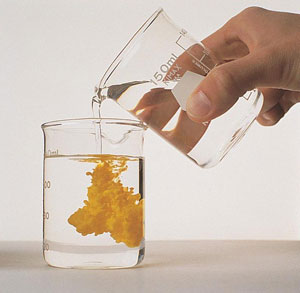 Think (way) back to the first day of class. I asked you what would happen if I mixed lead nitrate and sodium iodide. Some of you whipped out iPhones and Googled it, offering a prediction in under a minute that turned out to be true. Think about the science that that little prediction involved. First of all, there are the chemical theories which explain why a precipitate of lead iodide forms, why it’s yellow, &c. Then there are the theories of semiconductors and electronics that allow us to build computers, networks, and all the rest that make iPhones and Google possible. What is the best explanation of these impressive technical capabilities? Surely: the fact that these theories have the world in the relevant aspects more or less correct.
Anti-Realists think that this ideal is misplaced for various reasons. There are other competing explanations for the success of science; science has a history of advocating theories that later are overturned; our theories are in fact under-determined by the observational data; and so on. There are several anti-realist positions here — just as there are various realist positions which we’ll read more about in Chapter 8, some of them compromises made to the anti-realists under the pressure of their arguments.
Because we’re doing presentations on Thursday and continuing to discuss the issues we raise on Tuesday, there’s just one set of questions for this week.
Tuesday (11/15): Realism
• French, Ch. 7
• Stanford, Chs. 1–2 from Exceeding Our Grasp [PDF]*
Questions: (Respond to two)
- Are the contents of The Box observable or unobservable?
- Why is the observable/unobservable distinction more important for the anti-realist than the realist?
- What is your reaction to the pessimistic meta-induction?
- How does Stanford’s “Problem of Unconceived Alternatives” improve upon the pessimistic induction?*
- What seems to you the most worrisome argument against realism? Why?
Thursday (11/17): Finale of the Box Project & Continued Discussion
• Final Box Project Presentations
• Continued Discussion
Thursday, November 3, 2011
Week 12: Inference to the Best Explanation
Since we didn’t quite make it through our tour of the different accounts of explanation, I want to start the next class by talking a bit about the Unification and Causal accounts of explanation. We will then slide into a discussion of what seems to me our best hope of putting induction back on a decently secure footing in science: treating inductive inference as a species of explanatory inference — sometimes called ‘abduction’, but more often called ‘inference to the best explanation’ (or ‘IBE’). The basic idea is this: suppose we observe a bunch of green emeralds. What explains this fact (the fact that we’ve observed only green emeralds)? It seems that the best explanation is that all emeralds are green (not just the ones we happened to have observed). IBE tells us to infer that this explanation is correct: that is, to infer that all emeralds are green on the basis of observing many emeralds being green.
As Lipton points out, the IBE picture addresses both the descriptive and justificatory problems of induction. Not too surprisingly it is more obviously successful as a response to the descriptive challenge; Lipton is a little more reticent about its virtues in responding to the justificatory challenge. But even restricting ourselves to the descriptive challenge, IBE has its share of worries and pressing questions. Most obviously: What is the correct view of explanation? Lipton holds a particular version of the causal account that takes on board some the ideas we briefly touched on under the heading of pragmatics. On the justificatory side, I think that we might be able to say a little more than Lipton himself makes out. Some of that will have to wait for our discussion of Scientific Realism in Week 13, but you might start to think about the justification problem of induction again in the context of IBE. I told you it’d return! Make sure you have a look at my earlier FAQ on these issues so that we’re all on the same page about what the issues are.
On Thursday, we will turn our attention to a sort of partner strategy for thinking about induction. It is to think of inductive inference as being sanction by certain features of the world — in particular the existence of natural kinds. Natural kinds are supposed to be categories/groupings that have some sort of independent existence in nature. For example, consider the category emerald. Unlike the category things on my desk, its members seem to share a great deal in common. Moreover, there seems to be a particular reason they share a great deal in common — something to do with their underlying chemical structure, perhaps; something that makes them “natural” (in a bit of a slippery sense). How does this help with the problems of induction?
Start with the descriptive problem. Here I want to quote an important paper by the influential philosopher W.V.O. Quine at some length:
What tends to confirm an induction? This question has been aggravated on the one hand by Hempel's puzzle of the non-black non-ravens, and exacerbated on the other by Goodman's puzzle of the grue emeralds. I shall begin my remarks by relating the one puzzle to the other, and the other to an innate flair we have for natural kinds. Then I shall devote the rest of the chapter to reflections on the nature of this notion of natural kinds and its relation to science.
Hempel's puzzle is that just as each black raven tends to confirm the law that all ravens are black, so each green leaf, being a non-black non-raven, should tend to confirm the law that all non-black things are, non-ravens, that is, again, that all ravens are black. What is paradoxical is that a green leaf should count toward the law that all ravens are black.
Goodman propounds his puzzle by requiring us to imagine that emeralds . . . are now being examined one after another and all up to now are found to be green. Then he proposes to call anything grue that is examined today or earlier and found to be green or is not examined before tomorrow and is blue. Should we expect the first one examined tomorrow to be green, because all examined up to now were green? But all examined up to now were also grue; so why not expect the first one tomorrow to be grue, and therefore blue?
The predicate "green," Goodman says, is projectible; "grue" is not. He says this by way of putting a name to the problem. His step toward solution is his doctrine of what he calls entrenchment. . . . Now I propose assimilating Hempel's puzzle to Goodman's by inferring from Hempel's that the complement of a projectible predicate [that is, the things that are not picked out by that predicate] need not be projectible. "Raven" and "black" are projectible; a black raven does count toward "All ravens are black." Hence a black raven counts also, indirectly, toward "All non-black things are non-ravens," since this says the same thing. But a green leaf does not count toward "All non-black things are non-ravens," nor, therefore, toward "All ravens are black"; "non-black" and "non-raven" are not projectible. "Green" and "leaf" are projectible, and the green leaf counts toward "All leaves are green" and "All green things are leaves"; but only a black raven can confirm "All ravens are black," the complements not being projectible. (Quine 1969, 159-160).
So Quine’s idea here is that the are certain predicates — the ones that refer to natural kinds — which by virtue of their similarity are “projectible”. Howard Sankey — optional reading — is one (very optimistic) philosopher who wants to use this basic thought to solve the justificatory challenge by using natural kinds to rehabilitate the idea of the “uniformity of nature” — understood in a more specific and plausible way. Godfrey-Smith takes this sort of view as a jumping off point. However, he’s a bit more restrictive in how he thinks of the role of natural kinds in inductive inference. There are, he argues, two basic forms of inductive inference. One of them involves random sampling, using the randomness of the sampling as a sort of “bridge” from observed cases to the rest; the other involves natural kinds more explicitly. Here, he suggests, the extent of our sampling is far less important. This observation seems to me to explain a lot of our earlier hesitation/confusion about what was required of our samples/observations (how many, how varied, &c.?) in order for our inferences to seem secure.
As you will see, however, Godfrey-Smith is less concerned to respond directly to the inductive skeptic. One question we should talk about is whether what he says might be useful to the anti-skeptical project.
Tuesday (11/8): Inference to the Best Explanation
• Lipton, “Inference to the Best Explanation” [PDF] — on pp. 191–192 he begins assuming familiarity with Scientific Realism that you’ll get next week; read this, but don’t sweat it.
• White, “Explanation as a Guide to Inference” [PDF]*
(Lots of) Questions: (respond to two)
- Describe a case from ordinary life in which you recently used inference to the best explanation.
- Thinking back on any of your inferences about the contents of The Box, do any fit well with the IBE model? Describe one in some detail.
- Lipton is a little vague on what he has in mind by “vertical inferences”: try to explain more clearly what kind of inferences he’s referring to.
- What does Lipton mean about explanations being judged as “likeliest” vs. “loveliest”?
- What’s wrong with taking IBE to be an Inference to the Likeliest Explanation?
- Try to explain the “crucial ambiguity” White mentions on p. 7.*
- White offers an interesting solution to the Ravens Paradox that stems from explanatory considerations. Give a brief gloss of how his solution works.*
- Consider Lipton’s suggestion that explanation is often contrastive. What does this mean? Is he right?
- Lipton admits that meeting the “matching challenge” will “exacerbate the guiding challenge”. Why so?
Thursday (11/3): The Role of Natural Kinds in Inductive Inference
• Sankey, “Induction and Natural Kinds” [PDF]*
• Godfrey-Smith, “Induction, Samples, and Kinds” [PDF] — you may skim §4.
Questions: (respond to one)
- In Godfrey-Smith’s first form of inductive inference, how are we supposed to understand “random sampling”? In particular, how would we have to randomly sample emeralds to evade the grue problem?
- In the second form of inference, Godfrey-Smith suggests that numbers become less important and play a different sort of role. Explain clearly why numbers become less important in this form of inference and what role they do play.
- How do you suppose that the package of IBE+natural kinds might help us respond to the Humean challenge? If you don’t think they can at all, explain why.
Thursday, October 27, 2011
Week 11: Experiment and Explanation
After immersing ourselves in certain, messy social aspects of science, it’s time to return to the some of the questions about evidence for our theories that crop up at an individual level. For the next few weeks, we’ll descend back to the individual level — or anyway the level at which sociological factors drop out.
This week we tackle two very different concepts that are central to science: experimentation and explanation. Next week, we try to leverage explanatory considerations to solve (or at least make progress on) the problem of induction. After that, we’ll address a perennial concern for philosophy of science: the realism/anti-realism debate, drawing on lots of the background you’ve been acquiring. So much for foreshadowing. To the work at hand. . . .
Start with experiment. Do we even have a clear idea of what it is? How, for instance, does it differ from simple observation. (Of course, as we’ve already seen — both from reading French and Feyerabend —, observation isn’t nearly as simple as we’re often inclined to suppose.) How should experiments fit in with theories? Such questions are important not just theoretically, but (as O’Malley et al. argue) practically for how science is performed and funded. Their paper — published in a high-profile biology journal — examines some of the statements of funding agencies like the NSF and NIH to see how well they fit into our best understanding of how science works.
Our topic for Thursday will be explanation. What is it to explain something? I take it that we are often fairly good at offering and evaluating explanations. But once again we run into the problem of not being very good at describing what it is we’re doing. Strevens’ paper surveys some of the most popular and important accounts of scientific explanation (and the problems that they face). Though his paper doesn’t mention this specifically, you might think about the methodology of investigating these various models. How exactly are we (and should we) approach the question of whether an account of explanation is adequate?
Tuesday (11/1): Experiment & Models
• French, Ch. 6 (you might wish to review Ch. 5 as well)
• Hacking, “Experiment” (Chapter 9 of Representing and Intervening) [PDF]*
• O’Malley et al. “Philosophies of Funding” [PDF]
Questions: (respond to one)
- What is the difference between observation and experimentation? Describe as clearly and neutrally as you can (i.e., see if you can avoid using those words to explain the difference). Is there a clean division between the two?
- What do you think of Hacking’s view that phenomena are “created” by experiment — that they are, in a sense, artifacts of our technology? What would the consequences of this claim be, if true?
- Say something about how your think models fit into science. You might want to think back to the Oreskes/Conway reading.
- How do Hacking’s insights play a role in the O’Malley et al. paper?
Thursday (11/3): Explanation
• Strevens, “Scientific Explanation” [PDF] (you may skim the sections on the IS account and the Statistical Relevance account — I won’t address these in class unless someone specifically wants to).
• French, pp. 98–99 briefly considers explanation: you might wish to look this over at this point too (it’s in Ch. 7 on Realism, which we’ll read in a few classes).
Questions: (respond to one)
- Read Study Exercise 2 in French (p. 88). Address the questions: Do you think it’s possible to identify the cause of the crash? and Do you think scientists face a similar sort of situation when they try to explain some phenomenon?
- See if you can come up with a different example along the lines of the flagpole and storm examples that illustrates a problem for the DN account of explanation.
- Between the Unification and Causal approaches to explanation, what appears to you to be the most appealing and why?
- Address the methodological question I broached above.
Thursday, October 20, 2011
Week 10: Science in a (Messy) Social Context
We've been discussing some of the more overtly "social" aspects of scientific investigation of late via Feyerabend. And while I take it that he offered us many interesting and important insights, there is the strong sense that his medicine is rather strong. However he is working in an important tradition within philosophy of science: attempting to understand the sociology of science. Science is, after all, a particular human activity — something that we often do in groups — and thus potentially subject to social and psychological forces of which we may be only dimly aware.
This week, we'll examine different facets of these social factors. Prior to Feyerabend, our focus on confirmation theory was primarily individualistic. An individual scientist (or research group — a functional individual, in a sense) working on a particular problem proposes a hypothesis, makes relevant observations, does experiments, &c., that either raise or lower their confidence that the hypothesis is true. Suppose that our individual scientist’s confidence in the hypothesis is raised quite a bit: they come to (tentatively) accept the hypothesis as true. What then? Does the result become “scientific knowledge”?
That depends, at minimum, on its being accepted by a large portion of the wider scientific community. But in order for the result to even get heard be that community, it must cross an important gateway: peer-review. (Recall that this gateway has already made an appearance in this course: I insisted that your essays only draw from peer-reviewed sources.) In order for a result to be published, it must pass the scrutiny of other experts in the field, asking questions like “was the methodology used appropriate?”, “Were the assumptions reasonable?”, “Were the relevant calculations performed correctly?”, and so on. Inasmuch as these checks rule out obvious sources of error, it seems that passing this scrutiny ought to increase our confidence that a given paper’s conclusions are correct.
On Tuesday, we'll talk about some recent reflections on a biasing effect in peer-review that suggests that we shouldn’t be nearly as confident about our research results as we tend to be. On Thursday, we will look at an interesting case study for scientific norms revolving around peer-review, bias, and propaganda: the debate about SDI and Nuclear Winter.
Tuesday (10/25): Collective Research Effort and its Foibles
• Ioannidis, “Why Most Published Research Findings Are False” [Journal Link]*
• Lehrer, “The Truth Wears Off” [PDF]
• Schooler, “Unpublished results hide the decline effect” [Journal Link]
Questions: (respond to two)
- On its face, Ioannidis's claim is quite bold. Do you think he succeeds in making his case?*
- There are at least two different interpretations of statements of the “Decline Effect” (e.g., “our facts were losing their truth”, “the effects appeared to be wearing off”, and so on); carefully distinguish between them.
- Why does regression to the mean provide a more satisfying explanation for the decline effect than the hypothesis that certain effects are simply declining? Do you suppose that the subject matter of Schooler’s investigation (precognition) has anything to do with the plausibility of this suggestion or can it be made independently of the particulars of that experiment?
- Does the decline effect offer us a skeptical argument about science comparable to Hume’s argument about induction?
- Reflect on the relevance of Publication Bias for the competing theories of Popper and Feyerabend.
Thursday (10/27): Case Study: The “Star Wars” Defense Project & Nuclear Winter
• Oreskes & Conway, “Strategic Defense, Phony Facts, and the Creation of the George C. Marshall Institute” [PDF]
Questions: (respond to one)
- In what ways does it seem appropriate to think of strategic investigations as (analogous to) “scientific” investigations? Does the obvious phenomena of bias in the former suggest anything about the potential for bias in the latter?
- What can we say about the testability of SDI? Was it straightforwardly “untestable” or is there a way of nuancing our understanding of testability?
- How do you suppose Feyerabend might react to the whole SDI-Nuclear Winter affair?
- What do you make of the controversy over Sagan’s publications in Parade and Foreign Affairs prior to the peer-reviewed publication of the TTAPS paper? Did Sagan have a duty to publish or a duty not to publish?
- What is the Fairness Doctrine? Comment on its relevance to scientific and policy research.
- What do you think of Oreskes and Conway’s analysis of Seitz’s critique of the Nuclear Winter hypothesis?
Saturday, October 8, 2011
Weeks 8–9: Is There a Scientific Method?
Let’s review. We’ve examined some reason for concern over the idea that there is such a thing as “The Scientific Method”. The worries take various forms. For one, it appears difficult either to independently justify or to describe how scientists behave in different circumstances — even when we get close to such descriptions, they seem to fall apart under the pressure of certain philosophical thought-experiments or counterexamples. For two, it’s not clear that any of the attempts to attribute a special “scientific status” to certain theories have been successful or rule out even creationism or astrology.
One natural response to the second set of worries is to admit that a demarcation between science and non-science is bound to be vague, but that there are still clear cases of each. Compare: ‘bald’ is a vague concept, but there are certainly clear cases of bald people and “thatched” people. It might be difficult to come up with a demarcation criterion that provides even a vague separation between science and non-science, but that doesn’t mean that it’s impossible. Perhaps there are no necessary and sufficient conditions for a theory’s being a science; but this doesn’t mean that there’s nothing to say about the matter. To repurpose an example of Ludwig Wittgenstein’s, it might be difficult to offer necessary and sufficient conditions for something’s being a game — it’s a “family resemblance concept” — but that hardly means that there are no games or that games aren’t in some way special.
This response goes hand-in-hand with a natural response to the first set of worries: “Okay, so we learn that describing and justifying scientific methods (induction, testing, &c.) is difficult, but that shouldn’t surprise us much. And even if scientists fall short of behaving in the simple ways described by our models of these methods, they still have value as regulative ideals. Science is a rational enterprise even if individual scientists might not be entirely rational.”
Here’s were we pick up the story with Paul Feyerabend, whose thought we will study for at least three meetings. Feyerabend is an iconoclast in the philosophy of science. He has sometimes been called an epistemological anarchist, since he claims that the only rule of scientific methodology that deserves any assent is “Anything goes!” Feyerabend thus offers a rejoinder to the idea of scientific method as a regulative ideal. Scientists employ propaganda to convince others; they cajole, connive, misrepresent, believe when they shouldn’t. . . . And (here’s the radical thought): this is more or less as it should be! So buckle up for some radical views of science.
Thursday (10/13): Feyerabend’s Epistemic Anarchy
• Feyerabend, Against Method: Introduction, Chs. 1–4
Tuesday (10/18): Observation (Case Study: The Telescope)
• Against Method: Chs. 5–10 (skim pp. 79–82)
• French, Ch. 5
Thursday (10/20): The Social Status of Science
• Against Method: Chs. 11, 13, 15, 19 (Optional recommended: Ch. 17)
— 1st Box Project Presentation
Questions: Since we’re reading an anarchist, I thought it’d be an appropriate change of place to go a little anarchic with your Short Writing Assignments (#7 and 8) for a spell. For the next three meetings (those listed above), there are no particular questions to answer. Write on whatever interests you about the reading. These may be questions, descriptions, responses, or other sorts of reflections. We’ll revert back to normalcy in Week 10.
Wednesday, September 28, 2011
Week 7: Case Study for the Demarcation Question
Next week we’ll begin to consider the falsification model of science as a way of defining what science is. As you might expect, given the worries about falsification as a methodology for science, it doesn’t fare terrifically well as a demarcation criterion. But it’s important to see clearly why. Notice that falsification’s not being a great way of doing science doesn’t automatically entail that a necessary condition of a theory’s being scientific is that it’s falsifiable (of course, we might want to also have sufficient conditions — but it would be important enough to identify some features that scientific theories must have). This is how falsificationism came to be treated — even by Popper. Judge Overton used it this way in his (1982) opinion in McLean v. Arkansas Board of Education.
This is one of the things that worries Laudan. There are number of levels to the concern. For one, it’s not clear that creationism is not falsifiable; for two, it’s not clear that any theories (scientific or not) are falsifiable in the sense that Overton and other enthusiasts envision. And there are other concerns that shed some light both on the 1980s debate about scientific creationism (which fizzles today) and on his view of the nature of science. His debate with Michael Ruse, a philosopher of biology who testified in McLean, is the reading for Tuesday.
On Thursday, we’ll leap into the present by considering the status of intelligent design (ID) viz. the demarcation question. The recent trial in Dover, PA shines another public spotlight on the philosophy of science. And as before, many defenders of evolution by natural selection want to make a case for ID as non-science. But how good is this case?
Tuesday (10/4): Philosophy of Science in the Courtroom
• Readings from Thursday 9/29: Popper vs. Kuhn [PDF]
• Laudan, “Science at the Bar — Causes for Concern” and Michael Ruse, “Pro-Judice” [PDF]
Questions: (respond to one — questions from 9/29 are also fair-game)
- One might have the following reaction to Laudan’s commentary on the Overton decision: as long as the correct answer was reached, why should we worry too much about how it was reached it. How might one respond to this reaction?
- As Laudan shows, there’s a sense in which falsifiability is an extremely weak requirement. But as we’ve already seen, there’s another sense in which it is a very strong requirement. How could this be?! Isn’t this the same as the porridge being both too hot and too cold?
- Consider Ruse’s third objection to Laudan: that his conclusions and strategies “are simply not strong enough for legal purposes” (20). Evaluate this objection.
- Whose position do you find to be stronger: Laudan’s or Ruse’s? Explain your evaluation.
Thursday (10/6): The Intelligent Design Challenge
• Kitcher, "Disinterring Darwin" [PDF]
Questions: (respond to two)
- Why do you suppose Kitcher draws a distinction between “the architects of intelligent design theory” and those who “rally to their cause”?
- In what way(s) does the development of intelligent design (ID) in the wake of widespread abandoning of creation science connect with the claims of Laudan and Ruse?
- Given what Kitcher says about ID, do you think he would side with Laudan or Ruse?
- Briefly explain how Kitcher proposes to respond to intelligent design.
- Describe the differences between the three varieties of Darwin-detractors.
Thursday, September 22, 2011
Week 6: The Darwinian Model of Science: Or, How I Learned to Stop Worrying and Accept Inductive Skepticism. . . .
Before turning to Popper's “Darwinian model” of science, I want to begin our next class by briefly talking about Goodman’s “New Riddle of Induction”. Let me contextualize this important contribution a bit here so I can lecture to you less on Tuesday. So . . . we have this problem justifying inductive inference. It seems that we cannot show that it is a reliable form of inference (any more than I can show you that I am telling the truth by merely proclaiming “I’m telling the truth!”). That might not give us reason for doubting its reliability — or suspecting that we’d be better off with other inductive methods —, but it’s disquieting nonetheless. At this point, Goodman comes onto the scene, points out that attempts to solve the justificatory problem have a certain air of pathetic desperation (my phrase) about them (p. 61), and proposes to dissolve the problem rather than solve it. He writes:
Come to think of it, what precisely would constitute the justification we seek? If the problem is to explain how we know that certain predictions will turn out to be correct, the sufficient answer is that we don't know any such thing. If the problem is to find some way of distinguishing antecedently between true and false predictions, we are asking for prevision rather than for philosophical explanation. (Goodman 1983, 62)
Here’s where he makes the comparison between justifying induction and justifying deduction (see Foster p. 15 on this general strategy). “Principles of deductive inference are justified,” Goodman says, “by their conformity with accepted deductive practice. Their validity depends upon accordance with the particular deductive inferences we actually make and sanction” (63). In other words: rules of deductive logic are sanctioned only by the fact that they give us the results that we expect from them! Isn’t this circular!? Yes, “but this circle is a virtuous one” (64). So goes the thought. These are deep waters.
But suppose that this is on the right track. . . . The question then becomes What are the rules of inductive inference? Well, this is the problem of describing (rather than justifying) inductive inference. And as we’ve seen, it’s pretty hairy. The Hypothetico-Deductive model faces the “Tacking Problem”, the Instantial Model faces the “Ravens Paradox” . . . and yet these both seem like decent descriptions of how inductive inference operates in science. Scientists very commonly take instances of a generalization as supporting (confirming to at least some degree) the truth of that generalization. Observing that the consequences of our hypotheses are in fact borne out does seem to lend support to those hypotheses. Goodman’s “New Riddle” (see in particular §4 of his chapter) is another, arguably deeper puzzle about the instantial model. But it turns out to be one that has suggested new directions for addressing the justificatory problem in a more robust way — a subject we will return to later in the course once we have a bit more conceptual apparatus built up. . . .
But for the bulk of next week we will consider the perspective of Karl Popper — arguably one of the two most influential philosophers of science, the other being Thomas Kuhn — on two issues. The first issue (for Tuesday) pertains to the philosophical trauma we’ve so far endured on the justificatory problem of induction. Suppose neither the purported solutions nor Goodman’s dissolution satisfy us. What would happen if we just accepted the conclusion? This is Popper’s move. He writes: “My own view is that the various difficulties of inductive logic here sketched are insurmountable” (Popper 1959, 6).
Now shouldn’t this just scuttle science once and for all? Isn’t science up to its neck in induction? If what I claimed before about the triviality of deductive logic is right, wouldn’t this make science a trivial enterprise? Popper’s clever idea is to articulate a deductive model of theory testing. We can never confirm scientific theories (even in the weak sense we’ve been considering). What scientists do is attempt to falsify theories. And as we’ve seen, this is apparently a deductive business. If my hypothesis H implies that I should observe O, then if O is not observed, I know as a matter of deductive logic that H is false. Suppose now that I have a range of hypotheses: H1, H2, H3, . . . . If I falsify all but H1, what am I going to do? Probably pursue H1 a bit more — not in an effort to confirm it, but in more and more stringent attempts to falsify it. If I fail, time after time, Popper says that we should think of this theory as “corroborated” (rather than confirmed). So the model of science resembles natural selection: theories are proposed like mutations; then testing weeds out the less fit theories. We cannot say what remains is true, but can we not place more faith in it?
There are a number of worries about this approach, however. One we’ve already gestured to: the Duhem-Quine problem. Another is articulated in the optional paper by Wesley Salmon: what is it to “corroborate” a theory? Does a well-corroborated theory license any predictions? If the answer is ‘no’, then don’t we still have a problem?
The second issue (for Thursday) is whether Popper’s focus on falsification will allow us to answer a tricky question that we’ve been conveniently avoiding so far: What is science? Is it possible to decisively separate science from non-science or pseudo-science? We’ll continue discussing this issue in the context of important social issues in week 7 when we discuss the evolutionism/creationism/intelligent-design controversy as a case study. In that case, what we see is philosophy of science being played out in the courtroom!
Tuesday (9/27): The Evolutionary Model of Science
• French, pp. 49–59
• Popper, selections from The Logic of Scientific Discovery [PDF] ← Note that this was optional reading from (9/15); it is required for this class, however.
- Attempt to explain in your own words how Popper proposes to do science without induction.
- Why does the Duhem-Quine thesis (discussed in French, pp. 47–48) pose a problem for his “Darwinian model” of science.
- Consider Lakatos’s objection (quoted in French, pp. 58–59): “There is no falsification before the emergence of a better theory.” How might Popper respond to this objection?
- Salmon asks of Popper’s account why it should give us a guide to “rational prediction”. What is Salmon’s criticism here? *
Thursday (9/29): Falsification as Demarcation
• Popper, "Conjectures and Refutations"
• Kuhn, "Logic of Discovery of Psychology of Research" [PDF] <— This single file contains both articles.
Questions: (respond to one)
- At first glance, it might seem like a good thing for a theory to have a great deal of “explanatory power” or receive a lot of experimental/observational verification. Why does Popper think that it’s not (necessarily)?
- Suppose that you are a proponent of one of Popper’s pseudoscientific fields. Explain two distinct ways in which you might respond to Popper’s verdict about the value of your chosen field.
- Describe Kuhn’s criticism of Popper’s theory of demarcation.
Tuesday, September 20, 2011
Follow-up Questions for Induction
I want to start class next time by considering some of the proposed solutions to the justificatory problem of induction. I will then run you through the Ravens paradox quickly (since it's in a way not so dissimilar to the problem facing H-Dism) and start on Goodman's "New Riddle". So no further reading is assigned for Thursday. However, you will probably get more out of our discussion if you read the optional articles from last time.
Here are some additional questions to think about and/or write on (if you have not done an SWA yet for this week). (Write on one:)
Here are some additional questions to think about and/or write on (if you have not done an SWA yet for this week). (Write on one:)
- Foster compares two strategies for responding to the justification problem: saying something about the meaning of 'rational' and questioning the legitimacy of the challenge (see pp. 13–15). Explain this difference.
- Devise an analogy that helps to illustrate the justificatory problem of induction.
- If you've read the Godfrey-Smith reading: try to explain I.J. Good's solution to the Ravens Problem.
- If you've read Goodman: explain why "grue" emeralds are a problem for the instantial model.
Thursday, September 15, 2011
Week 5: Problems of Induction
We will continue our discussion of the problems of induction next week, starting class on Tuesday by making sure we are clear about the argument for inductive skepticism, its importance, and some of the potential responses to it discussed in Foster (please bring that reading again). I expect to spend most of our time on Tuesday talking about the justification problem and potential solutions.
As I mentioned, it turns out that justifying our inductive practices is only half the battle. Even describing them seems challenging. This was roughly the problem we faced with H-Dism: the simple formulation of that method seemed vulnerable to technical objections. It turns out that there are general worries about our ability to describe our inductive practices. We’ll discuss two: Goodman’s “New Riddle of Induction” and Hempel’s Ravens Paradox. I expect to only get to the Ravens Paradox on Tuesday — we’ll save the “New Riddle” for Thursday. Note that while the Goodman reading is optional, it is great. That is not to say that the ideas are easy: but it’s definitely worth reading (if nothing else than as an example of lovely, simple prose).
Reading for the Week: (Good thing I scheduled Thursday as a day for “breathing room”!)
• Goodman, "The New Riddle of Induction" [PDF]*
• Lipton, "Induction" [PDF]
• Godfrey-Smith, "The Ravens Problem" (§3.3 from his Theory and Reality)*
Questions: (respond to one; I’ll post more questions for Thursday that arise from our discussion.)
- According to Lipton, what is “underdetermination”? How does it play a role in arguments for inductive skepticism?
- Is the inductive skeptic trying to show that the inferences we often make in science are bad or that we need new methods for making inductive inferences? If not this, what is the inductive skeptic trying to do? Explain the intended conclusion of the inductive skeptic’s argument. How damaging is this conclusion.
- Explain clearly what the difference is between the descriptive and justificatory problems of induction.
- Lipton’s statement of the Ravens Problem for the Instantial Model is brief. But see if you can piece together the argument more specifically.
Wednesday, September 7, 2011
Week 4: Verification & Confirmation
Next week, we’ll be switching gears from the “Context of Discovery” to the so-called “Context of Justification”. An apparently motley collection of questions come up here, which will largely occupy us through fall break: How do scientific theories receive support from hypotheses? How do we gauge the strength of this support? Can we offer any justification for treating evidence the way we do? How does all this bear on whether a theory counts as scientific in the first place?
On Tuesday, we’ll think again about the Hypothetico-Deductive account of confirmation that we encountered back in Week 2. Though Hempel’s description of it was rather plausible, it faces a number of problems. One problem we will be rather quick with: it involves using the idea of verification as a way of separating science from other fields (such as metaphysics). What’s metaphysics? French is brief because the question is tricky (true generalizations about metaphysics are scarce), but let me say a bit more than French does.
Despite what bookstores might have you believe, Metaphysics (in philosophy, anyway) does not concern fortune-telling, divination, or astrology. Rather, it concerns a cluster of topics about certain fundamental features of the world (including ourselves) that are not clearly susceptible to empirical treatment from the sciences. For example, many metaphysicians wonder whether we have free will. While results from physics or neuroscience may bear on this question, it is far from obvious that they’d be able to settle it. Conceptual work looks like it’d be necessary. Ditto for other paradigmatically metaphysical questions, such as when some objects compose other objects, how they persist, whether there are any “abstract objects” (such as numbers or qualities), what the nature of time or causation is, and so on (for more, you might check out the Stanford Encyclopedia of Philosophy (“SEP”) entry on Metaphysics). There’s currently a vigorous debate in philosophy about what the proper relationship is between metaphysics and science, but for a long time many philosophers (particularly, the Logical Positivists) got so sick of metaphysical pronouncements that they attempted to construct ways of showing not only what made science special but what made metaphysics worthless: there was no way of verifying metaphysics claims, they said. Perhaps such claims are even meaningless. They’re like “Green ideas sleep furiously”: while they might seem meaningful at first glance, they don’t really mean anything. How would one verify that green ideas do sleep furiously? (“Well, first you get some green ideas. . . .”)
There are a number of reasons why this tempting idea doesn’t work in general. As French explains, as the fortunes of the verification camp waned, an emphasis on confirmation took its place. This is roughly the context in which we find Hempel working: attempting to clarify how confirmation works. One of the interesting dynamics we’ll take an extended look at over the next few meetings is the tension between the feeling that something like his account is on the right track (at least descriptively!) but finding it devilishly difficult to get the details right.
On Thursday, we will discuss one of the most famously difficult problems in philosophy: the problem of induction and its relevance for scientific confirmation. It is in fact what drives Karl Popper to his fascinating views about science as a series of “conjectures and refutations” — a view we will discuss in more detail in weeks five and six. The problem is generated by asking a simple question: how is inductive inference to be justified? How can we show that the methods we use to infer from specific observations the very general facts (that all emeralds are green, that tigers are carnivorous, that material objects obey F=ma, &c.) that science is awash with are good or reliable methods? The inductive skeptic (spelled ‘sceptic’ in Foster’s article) denies that this is possible. She doesn’t deny that our inductive efforts have been successful. That is not at issue. That is obvious. The question is what, if any, reason such past success gives us for thinking that our inductive methods will continue to be successful. The skeptic offers us a compelling argument that there is nothing about our previous experience that should incline us even toward the probability that things will continue as they have. It turns out that the skeptic’s argument is very difficult to rebut. No one (in my view) has yet done so successfully. However, I’m not ready to give up on inductive inference. The stakes are too high: according to many, the rationality of science hangs in the balance!
Tuesday (9/13): Verification & Confirmation
On Tuesday, we’ll think again about the Hypothetico-Deductive account of confirmation that we encountered back in Week 2. Though Hempel’s description of it was rather plausible, it faces a number of problems. One problem we will be rather quick with: it involves using the idea of verification as a way of separating science from other fields (such as metaphysics). What’s metaphysics? French is brief because the question is tricky (true generalizations about metaphysics are scarce), but let me say a bit more than French does.
Despite what bookstores might have you believe, Metaphysics (in philosophy, anyway) does not concern fortune-telling, divination, or astrology. Rather, it concerns a cluster of topics about certain fundamental features of the world (including ourselves) that are not clearly susceptible to empirical treatment from the sciences. For example, many metaphysicians wonder whether we have free will. While results from physics or neuroscience may bear on this question, it is far from obvious that they’d be able to settle it. Conceptual work looks like it’d be necessary. Ditto for other paradigmatically metaphysical questions, such as when some objects compose other objects, how they persist, whether there are any “abstract objects” (such as numbers or qualities), what the nature of time or causation is, and so on (for more, you might check out the Stanford Encyclopedia of Philosophy (“SEP”) entry on Metaphysics). There’s currently a vigorous debate in philosophy about what the proper relationship is between metaphysics and science, but for a long time many philosophers (particularly, the Logical Positivists) got so sick of metaphysical pronouncements that they attempted to construct ways of showing not only what made science special but what made metaphysics worthless: there was no way of verifying metaphysics claims, they said. Perhaps such claims are even meaningless. They’re like “Green ideas sleep furiously”: while they might seem meaningful at first glance, they don’t really mean anything. How would one verify that green ideas do sleep furiously? (“Well, first you get some green ideas. . . .”)
There are a number of reasons why this tempting idea doesn’t work in general. As French explains, as the fortunes of the verification camp waned, an emphasis on confirmation took its place. This is roughly the context in which we find Hempel working: attempting to clarify how confirmation works. One of the interesting dynamics we’ll take an extended look at over the next few meetings is the tension between the feeling that something like his account is on the right track (at least descriptively!) but finding it devilishly difficult to get the details right.
On Thursday, we will discuss one of the most famously difficult problems in philosophy: the problem of induction and its relevance for scientific confirmation. It is in fact what drives Karl Popper to his fascinating views about science as a series of “conjectures and refutations” — a view we will discuss in more detail in weeks five and six. The problem is generated by asking a simple question: how is inductive inference to be justified? How can we show that the methods we use to infer from specific observations the very general facts (that all emeralds are green, that tigers are carnivorous, that material objects obey F=ma, &c.) that science is awash with are good or reliable methods? The inductive skeptic (spelled ‘sceptic’ in Foster’s article) denies that this is possible. She doesn’t deny that our inductive efforts have been successful. That is not at issue. That is obvious. The question is what, if any, reason such past success gives us for thinking that our inductive methods will continue to be successful. The skeptic offers us a compelling argument that there is nothing about our previous experience that should incline us even toward the probability that things will continue as they have. It turns out that the skeptic’s argument is very difficult to rebut. No one (in my view) has yet done so successfully. However, I’m not ready to give up on inductive inference. The stakes are too high: according to many, the rationality of science hangs in the balance!
Tuesday (9/13): Verification & Confirmation
French, pp. 43–49
Hempel, “Criteria of Confirmation and Acceptability”* [PDF]
Note: The Hempel paper here is optional supplementary reading — it’s really interesting, though, and I will discuss it in class, so I recommend you read it. But I won’t count on you having read it, though I think it’s worth reading. In the future, I will merely mark these sorts of “further reading” assignments with an asterisk.
Questions: (respond to two)
- Does “verifying” a theory mean showing that the theory is definitely true? Why or why not?
- Try to state the argument against using the verification principle as a demarcation criterion as clearly as you can (and in your own words, of course).
- French mentions “a more plausible” version of the verification stance on p.47: that the “greater then number and variety of verifications the greater the support for the theory and the higher the probability of its being true”. Can you think of ways in which this simple statement is pretty clearly too simple?
- Explain in your own words the Quine-Duhem problem (as conveyed by French).
Thursday (9/15): The Problem of Induction
Foster, "The Problem of Induction" [PDF] — note: you can safely ignore for now the bit about Goodman on p. 5 (we’ll get to Goodman properly soon enough)
Popper, selections from The Logic of Scientific Discovery [PDF]*
You might wish to look over pp. 17–23 of French again before diving in to this week’s reading.
Questions: (respond to one)
- Why can’t one validly deduce from the premises that unsupported coins have always fallen that this coin will fall if I release it? Explain as clearly as you can.
- Why does it not help to rely on a principle about the uniformity of nature? Can you think of reasons other than those mentioned by Foster for being skeptical about such a principle?
- Can the inductive skeptic be reasonably interpreted as urging us to be modest about drawing general conclusions from particular matters of fact?
- Choose one of the three rebuttal strategies that Foster discusses in §IV: rephrase the debate in your own way, adding clarifications or raising questions you deem appropriate.
Thursday, September 1, 2011
Week 3: Analogies & Heuristics
As I mentioned, class on Tuesday will be run by my “academic brother” [i.e., we had the same Ph.D. advisor], Professor Gary Hardcastle. I will be at a conference in Spain. (Don’t hate me, please.) At the end of class, Professor Hardcastle will give you approximately 20 minutes to sort yourselves into groups to work on the box project. You’ll spend Thursday working with your group to formulate an initial plan for the project. The academic assistant for Philosophy, Jane Baker will provide you with further instructions when you come in on Thursday. If you want to go off and meet elsewhere (like 7th St. or some such), that’s fine, but I would like everyone to show up, sign in, and actually use the time to meet — it shouldn’t take longer than the usual class time to do what I’ll ask you to do.
So far, we’ve seen two models of how science gets done: the overly mysterious and romantic view that puts genius and creativity on an unassailable pedestal and the meticulous inductivist view. And we’ve seen a few reasons for being worried about those models, at least in their simple formulations (we’ll actually encounter the inductivist view in a more sophisticated incarnation in Week 5). French presents the heuristics approach as a third model. But there are worries here too. First, we humans tend to be pretty easily seduced by fallacies (recall the fallacy of affirming the consequent that Hempel mentioned in his article from last week). Second (and relatedly), we suffer from all manner of cognitive biases. Nevertheless, we can identify all manner of cases of scientists apparently employing “heuristic” moves to press their research further. The chapter outlines and discusses some of these moves in the context of brief case studies. You might think as you read about why such heuristic moves were made in the first place and how they came to be.
Tuesday (9/6): Heuristics and Analogies
French, Ch. 4.
Questions: (respond to two) Please CC Professor Hardcastle <ghardcas at bloomu.edu> on your responses.
- Think about why concerns about fallacies and cognitive biases are arising in this context. Why should they not equally be a problem for the Romantic or inductivist models?
- How seriously do you think we should take the sorts of concerns French raises in the first part of the chapter for his discussion of particular heuristic moves in the remainder?
- Not surprisingly, French chooses cases where the heuristics (by and large) worked out. Can you think of cases where a particular heuristic move did not?
- How do you think that the heuristics picture fares in comparison to the others we’ve looked at so far?
Thursday (9/8): Project Work Day
No required reading. Please show up in our usual room with your group already formed. Jane will deliver instructions for how to begin the box project.
Thursday, August 25, 2011
Week 2 Reading & Questions: Creativity and Methodology
We’ll continue talking about scientific methodology next week, spending a bit more time on what French calls “the Romantic view” of scientific discovery and then talking in more detail about the context of justification. It seems fairly clear that French is a bit skeptical of this view. But as he makes clear, it really is a very common way for scientists to characterize what they do — and we need to take that seriously at least as a starting point.
On Thursday, we will read a classic exhibition of the Hypothetico-Deductive model of scientific inquiry by Carl Hempel. Though very readable, there are several instances of logical argument schema like this (see p. 7):
Tuesday (8/30)
French, Science: Key Concepts in Philosophy, pp. 1–17 [In the future, I'll list this book as just 'French’.].
Questions: Respond to two of the following prompts in less than a page (e.g., a short paragraph or two/each should be plenty).
Hempel, "Scientific Inquiry: Invention and Test" [PDF]
Note: the PDF links should take you directly to the article, provided that you are logged into Moodle. If that doesn't work, you can simply find the articles on our Moodle page.
French, pp. 17–23
Questions: (respond to two)
2a]You may not be familiar with this notational convention. The line is indicating that this is an argument. The sentence that comes after the line is the conclusion; the sentences above the line are premises (that is, reasons or justifications for believing the conclusion). I’ll say a bit more on Tuesday about some of these logical concepts to get us ready to talk about the H-D model in detail. Here’s the reading assignment along with some questions/prompts to think about and write on. Remember: I’m asking you to respond to just one set each week — your choice which day, but I’d like the papers pertaining to a given day’s class before that class. Let me know if you have any questions. Feel free to leave a comment on the blog, if others might profit from hearing the answer.
If H is true, then so is I.
But (as the evidence shows) I is not true.
H is not true.
Tuesday (8/30)
French, Science: Key Concepts in Philosophy, pp. 1–17 [In the future, I'll list this book as just 'French’.].
Questions: Respond to two of the following prompts in less than a page (e.g., a short paragraph or two/each should be plenty).
- French discusses in the Introduction a few ways for figuring out “how science works”: listening to the scientists and observing scientific practice (pp. 2–3). How do his comments on these two strategies relate to his remarks on the “Romantic view” of scientific discovery.
- Do you think creativity needs to be “irrational”? Must it be connected with genius?
- If French is cautious about the Romantic view of creativity, Feyerabend clearly hates it. Explain why French does not think Feyerabend’s argument against it is very good. (Can it be improved?)
- Consider French’s (apparent) suggestion that the Romantic view is “a bit of a myth” (15). What reasons does French offer for thinking this? Do they seem compelling to you? Why or why not?
Hempel, "Scientific Inquiry: Invention and Test" [PDF]
Note: the PDF links should take you directly to the article, provided that you are logged into Moodle. If that doesn't work, you can simply find the articles on our Moodle page.
French, pp. 17–23
Questions: (respond to two)
- Does Hempel’s discussion of Semmelweis’s discovery of the causes of puerperal fever fit naturally with the Romantic view of discovery? Does it suggest any modifications to Romanticism?
- Hempel makes the point that “the fact that a test implication inferred from a hypothesis is found to be true, does not prove the hypothesis to be true” (8). Compare this point with the discussion of the swans in French.
- Do you think that the Inductive Account of discovery offers a reasonable replacement for the Romantic view? Explain.
- Toward the end of Ch. 2, French considers an argument for the conclusion that “science proceeds by making observations and using induction” (21). But something worries him (even setting aside his claim about their being counter-examples). Explain this worry clearly.
Wednesday, August 24, 2011
Schedule for Weeks 1–3
Here a sketch of what we'll be doing over the next few weeks. Detailed posts will follow with reading questions to address in your short writing assignments nearer the days in question. In general, when there are multiple readings, I'll list them in the order in which it makes most sense to me to read them (including the optional readings).
Week 1:
Thursday 8/25:
Week 2:
Tuesday 8/30:
Thursday 9/1:
Week 3:
Tuesday 9/6:
Thursday 9/8:
Week 1:
Thursday 8/25:
- French, Science: Key Concepts in Philosophy, Introduction (if you spot this in time — otherwise, just read it for Tuesday).
Week 2:
Tuesday 8/30:
- French, Science: Key Concepts in Philosophy, pp. 1–17 [In the future, I'll list this book as just 'French'.]
Thursday 9/1:
- Hempel, "Scientific Inquiry: Invention and Test" [PDF]
- Note: the PDF links should take you directly to the article, provided that you are logged into Moodle. If that doesn't work, you can simply find the articles on our Moodle page.
- French, pp. 17–23
Week 3:
Tuesday 9/6:
- French, Ch. 3
Thursday 9/8:
- Project Work Day (no reading: details TBA)
Subscribe to:
Posts (Atom)